
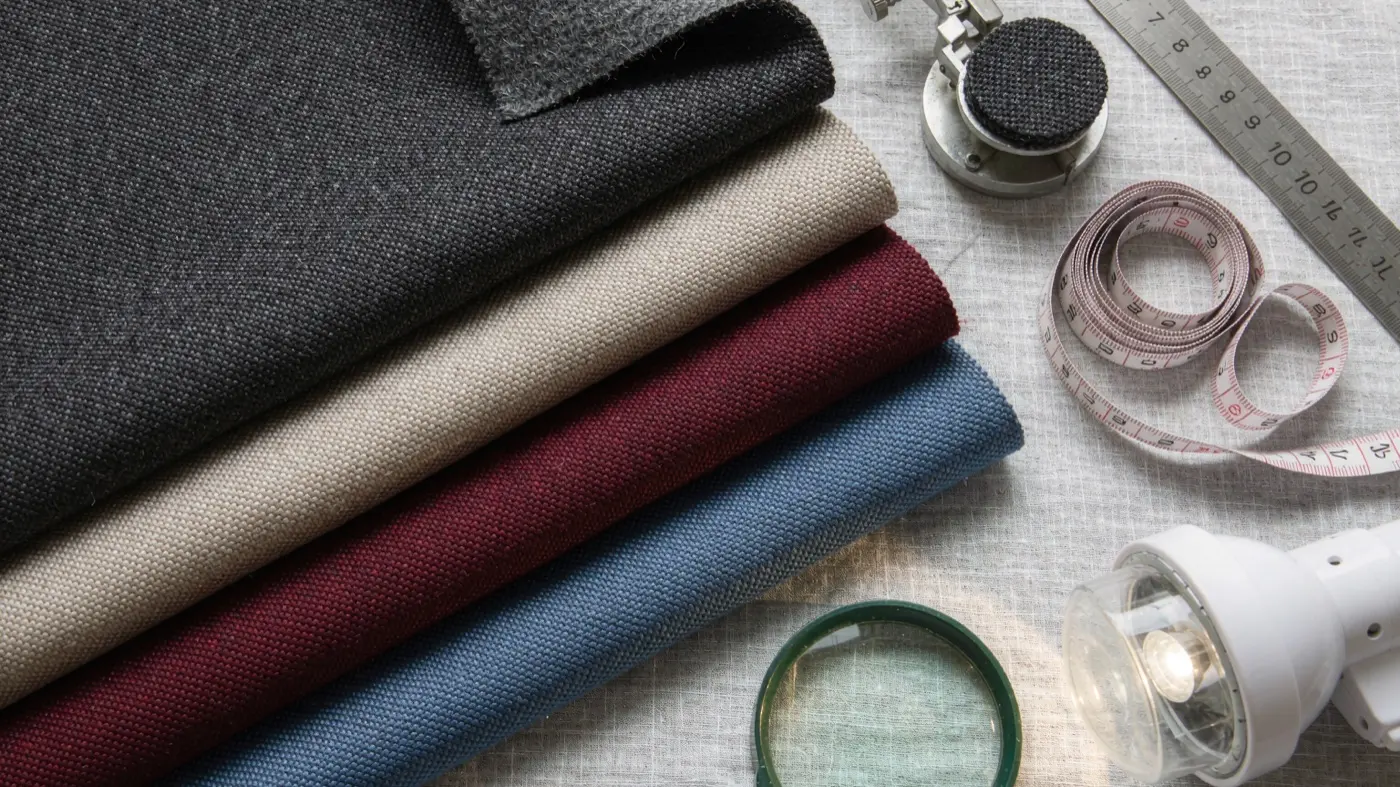
A bonded fabric inspection checklist is a written list of tests, test methods and acceptance limits agreed with the mill before the purchase order. Run it at three checkpoints: the approval sample, the bulk-lot swatch, and pre-shipment roll inspection.
The six failure modes to test on wool-feel bonded fabric:
- Bond strength and delamination under wash, dry cleaning and pressing heat
- Pilling, abrasion and snagging
- Colorfastness and shade consistency across rolls
- Shrinkage, GSM, usable width, bow and skew
- Odour and chemical compliance for the destination market
- Visual grading by AQL and the 4-point system
Every limit in this checklist should be agreed in writing before bonding starts. Here is how to inspect bonded fabric quality before a bulk order, method by method.
A coat line is rarely lost at the mill. It is lost at the cutting table, when the roll opens and the face fabric lifts away from its backing in bubbles, or at the finishing press, when the front edge of a jacket puckers into a permanent ripple. By then the fabric is cut, trims are booked and the shipping window has gone.
The cheapest insurance in this business is one washed test panel cut from the actual bulk lot. It costs a few metres of fabric and one wash cycle. It tells you more than any sales sample, because it tests the single thing that separates bonded fabric from ordinary coating-weight cloth: the adhesive line between face and backing.
Our wool-feel bonded fabrics run in two constructions, chosen per style: a face cloth bonded to a 140 GSM jersey backing, or to a 220 GSM fleece backing when the garment needs more loft, warmth or structure. Each behaves differently under water, under the press and in dry-cleaning solvent, which is why a generic fabric test is not enough. You can review the constructions on the wool-feel bonded fabric product page.
This article is written from the QC side of a bonded fabric mill in Keqiao, Shaoxing, operating since 2014. What you leave with is a bonded fabric inspection checklist: which tests belong at which stage of the order, which standard number to cite for each, and how to judge the result without inventing acceptance numbers that your supplier never agreed to.
Where Each Check Belongs in Your Order Timeline
Most inspection budgets are wasted in one of two ways: everything is tested on the approval sample and never again, or everything is tested after the container is packed. Both are too late. Split your bonded fabric QC into three checkpoints.
| Stage | Sample you hold | Tests worth doing | Who pays |
|---|---|---|---|
| Approval sample (before PO) | Lab dip or 1 m approval length | Hand, shade, weight, width, quick peel check by hand, one exploratory wash cycle | Buyer, often credited against the order |
| Pre-production bulk swatch | 1 to 3 m cut from the running bulk lot | Full wash or dry-clean panel, shrinkage in warp and weft, crocking, pilling, peel strength | Mill, confirm in writing before PO |
| Pre-shipment roll inspection | Defined share of finished rolls, head, middle and tail | 4-point visual grading, usable width, GSM check, odour, shade banding against the continuity band | 【agree per style】 (commonly the buyer or a nominated inspector) |
Timing matters more here than in most fabric categories. Minimum order quantity is 1 roll, approximately 100 m, and production lead time runs 7 to 15 days. That window is too short to approve, test, reject and remake. So request the bulk-lot swatch while production is running, not after it is packed, and book any third-party testing before the order goes on the machine. The mechanics of that request, including how much to ask for and how to label it, are covered in how to request fabric samples from a China supplier.
Lock the Spec Before You Test
“Good quality” is not a specification and it cannot be tested. Every test you plan to run needs three things fixed in writing before the PO: the method number, the edition, and the acceptance value. Without the third item, a test report is decoration.
Two practical rules follow. First, cite the standard with its version and require the date of test, because ISO, AATCC and ASTM methods are revised and an obsolete edition can produce a result your customer will not accept. Second, ask the mill for its own internal QC limits in writing. A mill that states its internal peel strength limit will usually also tell you which styles sit close to that limit, and those are the styles worth testing hardest.
Minimum Spec Sheet for a Bonded Fabric Order
| Parameter | What to specify | Test method | Typical starting range | Owner |
|---|---|---|---|---|
| Construction | Face composition and weave, backing type and backing GSM, bonding process | Mill spec sheet, countersigned by buyer | Face bonded to 140 GSM jersey or 220 GSM fleece backing, per style | Mill |
| Finished weight | GSM with tolerance, reported as average AND minimum | ISO 3801 or ASTM D3776 | 460 to 520 GSM in regular production | Mill |
| Finished and usable width | Nominal width and usable width after excluding selvedge and pin marks, in cm, with minus tolerance | ASTM D3774 or ISO 22198 | Approximately 160 cm nominal | Mill |
| Roll length | Metres per roll, minimum acceptable short length, share of short rolls allowed | Mill packing list, verified at goods receipt | Approximately 100 m per roll | Mill |
| Shade reference and colour tolerance | Reference standard (lab dip or Pantone), instrument tolerance in ΔE, under two light sources, observation geometry | Instrumental measurement plus ISO 105-A02 or AATCC grey scale for fastness | 【set with your supplier】 | Buyer and mill |
| Claim window | Number of days after delivery during which hidden defects (delamination after washing, bubbling after pressing) can be claimed | Contract clause, not a laboratory test | 【agree per style】 | Both |
Note the split between nominal and usable width. A fabric sold at approximately 160 cm nominal can lose several centimetres to selvedge, pin marks from the stenter, or crease damage at the edges. Your marker needs the usable figure, and that is the figure the mill should commit to.
Failure Mode 1: Bond Strength and Delamination
Delamination is the failure that ends a bonded garment, and it has two distinct trigger moments.
The first trigger is water: domestic washing or commercial dry cleaning. Water and detergent attack the adhesive line, and mechanical action works on it at the same time. The second trigger is heat: fusing, steam pressing, and final garment finishing. Heat can soften an adhesive that survived the wash, which is why a panel that looks perfect out of the washing machine can still bubble under the press.
Relevant methods:
- Bond strength: ASTM D2724 / D2724M for bonded and laminated apparel fabrics, or ISO 11339 (T-peel) for the adhesive joint, with results reported as force per unit width and the failure mode (adhesive failure, cohesive failure, or fabric tear) recorded.
- Wash appearance: AATCC TM 124 after repeated home laundering, with washing performed per ISO 6330, assessed against the ISO 105-A02 grey scale or AATCC photographic standards.
- Dry cleaning: ISO 105-D01 for colour fastness to dry-cleaning solvent, and ISO 3175-2 where you need a full commercial dry-cleaning and finishing cycle rather than a solvent dip.
The 20-Minute Test Any Factory Can Run
You do not need a laboratory to catch most delamination risk. This sequence takes one operator, a washing machine and your own press.
- Cut a 30 x 30 cm panel from the actual bulk lot, not from the approval sample, and record the roll number and dye lot on a tag pinned through a corner.
- Mark a 25 x 25 cm square on the face with a fade-resistant marker. The marked square is your shrinkage reference and your distortion reference at the same time.
- Run three full cycles using the programme, temperature and drying method stated on the intended care label. Follow ISO 6330 for the wash parameters, and add ballast if the machine is underloaded so the mechanical action is realistic.
- Inspect under raking light. Hold a lamp at a low angle across the surface rather than straight down. Bubbles, ripples, quilting and edge lift are invisible under overhead light and obvious under raking light.
- Steam-press half the panel at your own line’s press temperature, pressure and steam setting, for three passes, then compare the pressed half against the unpressed half in raking light.
- Judge and record. Any bubbling, any lift at the cut edge, any visible seam delamination, or a boardy and stiff change of hand means do not cut. Pass is no visible change; the minimum retained peel value after washing is 【agree per style】.
Repeat the whole sequence on the dry-clean-only styles with solvent instead of water. The two routes do not predict each other.
Bonded-Specific Defects Worth Naming in Your Contract
Generic fabric defect lists miss the defects that are unique to bonding. Put these in writing by name:
- Strike-through: adhesive penetrating to the face, appearing as stiff spots, shine, or a change of colour depth. It is often invisible in the roll and obvious after pressing.
- Edge and seam delamination: layers separating at cut edges, hems and seam allowances, usually the first place a weak bond shows.
- Bubbles after garment pressing: the classic post-finishing failure, and the reason step 5 above uses your press, not a laboratory hot plate.
- Adhesive yellowing or odour after container heat: weeks sealed in PE bags in a hot container can change both colour and smell. See the odour section below.
- Poor recovery where the backing is too light for the design: a structured blazer or a stand collar needs the 220 GSM fleece backing to hold shape. A 140 GSM jersey backing is the right choice for softer, unlined or lighter constructions, but it will not support a sharp, tailored front. Structural expectations belong on the spec sheet, not in the pattern room. For a sense of how these constructions are used in tailored garments, see jacket and blazer fabric applications.
Failure Mode 2: Pilling, Abrasion and Snagging
Pilling is graded on a 1 to 5 grey scale where 5 is no change, and it is only meaningful next to the abrasion a specific garment actually receives. Judge the fabric where the garment rubs: cuff and pocket mouth, underarm, front edge and collar back for outerwear; inner thigh, seat and hem for trousers; and, for skirts and dresses, the area under a bag strap or against a coat lining.
Methods:
- Pilling: ISO 12945-1 (pilling box) and ISO 12945-2 (modified Martindale), or ASTM D3512 (random tumble pilling). Agree which method, because the three do not give interchangeable grades.
- Abrasion: ISO 12947-2 or ASTM D4966 (Martindale), reported as cycles to breakdown plus a visual grade, or as mass loss, depending on what you specify.
- Snagging: not always included by default; add it explicitly for open or loopy structures.
Suggested Starting Grades by Application
| Application | Pilling target | Abrasion target | Where it fails first |
|---|---|---|---|
| Coat, outerwear | 【agree per style】 | 【agree per style】 | Cuff, pocket mouth, front edge, underarm |
| Blazer and jacket | 【agree per style】 | 【agree per style】 | Front edge, underarm, collar back, cuff |
| Trousers | 【agree per style】 | 【agree per style】 | Inner thigh, seat, hem, pocket bag |
| Skirt | 【agree per style】 | 【agree per style】 | Seat, bag strap contact zone, hem |
Set the target grade higher for garments expected to survive several seasons, and set the abrasion cycle count by reference to the garment’s real service life rather than to a round number.
Texture changes the risk profile, sometimes in your favour. Jacquard floats abrade at the peaks of the pattern first, so a structured jacquard can lose surface definition well before it loses strength; construction and float length matter more than fibre content here. Bouclé and loop yarns snag rather than pill, and a snag grade is more informative than a pilling grade on those styles. Mélange and heather effects hide early pilling visually, which is a benefit for the wearer and a hazard for the QC team, because the defect appears later in the garment’s life than the rating suggests. Details on the constructions are on the jacquard and tweed and bouclé pages, and trouser-specific selection guidance is in how to choose wool-feel bonded fabric for women’s trousers.
Failure Mode 3: Colorfastness and Shade Consistency
Bonding adds a process step that can shift shade, so colour work has two halves: fastness testing and shade control.
Fastness methods to specify:
- Crocking (rubbing), dry and wet: AATCC TM 8 or ISO 105-X12. Wet crocking is usually the limiting result on dark shades.
- Washing: AATCC TM 61 or ISO 105-C06, with the test number and temperature agreed.
- Perspiration: ISO 105-E04 (acid and alkaline), relevant for linings, collars and cuffs in contact with skin.
- Light: AATCC TM 16 or ISO 105-B02, with the exposure level agreed.
- Dry cleaning: ISO 105-D01.
Fastness results are read against the grey scale for colour change and for staining, each graded 1 to 5, with 5 indicating no change or no staining. A result written only as “pass” is unusable: require the numeric grade for change and for staining separately, plus which adjacent fibre was stained in multi-fibre tests.
Shade control is a separate discipline and it is where most disputes start:
- Selvedge to centre: compare measurements taken at both selvedges and at the centre of the same roll. Bonding, heat setting and finishing can produce a measurable centre-to-selvedge difference on wide fabrics.
- Head, middle and tail: take readings from all three positions. Tail-end shading within a roll is common and it is exactly what a head-only inspection misses.
- Roll to roll: build a shade continuity band, signed or countersigned by both parties, and sort rolls into the band before cutting. Cutting by shade band is far cheaper than re-cutting a mismatched garment.
- Light sources: evaluate under D65 as the primary source and a secondary store source such as TL84 / 845 or CWF to catch metamerism, where two panels match under one light and separate under another.
- Tolerance: the ΔE limit, the formula used and the light source must be agreed in writing as 【set with your supplier】.
Accept a wider shade spread on certain constructions, and say so in the contract rather than discovering it during inspection. Mélange and heather yarns vary within the yarn itself, and tweed and Donegal-style effects vary by design. A tight numeric ΔE on a mélange twill will generate rejections that have nothing to do with quality.
Failure Mode 4: Shrinkage, Weight, Width, Bow and Skew
Dimensional testing on wool-like fabric needs three separate measurements, not one.
Shrinkage in laundering: AATCC TM 135 or ISO 6330, with specimens prepared per ISO 3759 and calculation per ISO 5077. Report warp and weft separately, and state the residual shrinkage after the number of cycles you specified. One cycle tells you about the first wash; three cycles tell you about the garment’s life.
Free-steam shrinkage: ISO 3005. This is the test that matters most for wool-feel fabrics, because it predicts behaviour under the steam press and the finishing tunnel rather than under the washing machine. A fabric with acceptable wash shrinkage can still shrink locally under steam, and that is what produces a bubbled front edge and a hem that no longer hangs.
Relaxation: bonded rolls carry tension from winding and bonding. Relax them 24 to 48 hours flat in the cutting room before spreading. Cutting relaxed fabric is the single cheapest defence against panels that move after the first press.
Weight: ISO 3801 or ASTM D3776, with at least three specimens taken across the width, not three from the same area. Report the average AND the minimum, because a roll that averages the target GSM can still taper below it at one selvedge. Watch for two specific causes: weight tapering across the width, and a heavy or resin-rich selvedge that inflates the average while the usable centre is light. Regular production sits in the 460 to 520 GSM band; the reason that band exists, and how it translates into garment performance, is explained in understanding fabric weight GSM for winter outerwear.
Width: measure nominal and usable separately, and make the usable figure the acceptance criterion. Approximately 160 cm nominal is the reference for this range, but the marker needs the number after selvedge and pin marks are removed.
Bow and skew: ASTM D3882. Bonding can introduce skew if the two layers are fed under different tension, and a bowed or skewed fabric is immediately visible in a pattern with a strong line. Treat bow and skew as critical for herringbone and any large-repeat check or stripe, and set the maximum as 【agree per style】.
Failure Mode 5: Odour and Chemical Compliance
Bonded fabrics are more odour-prone than single-layer fabrics for two reasons: the adhesive chemistry itself, and the logistics. A roll can be bonded, wound, bagged in PE and sealed for weeks, then shipped in a container that reaches high internal temperatures. Whatever volatile residue was trapped at the bonding machine arrives with the goods.
The practical control is simple: open the rolls and air them 24 to 48 hours in a ventilated area before you make any cutting decision. Do not judge odour on a roll that has just been opened from a sealed bag, and do not judge it after the fabric has been in a hot room all day.
Chemical items to write into the spec:
- Formaldehyde: ISO 14184-1 or AATCC TM 112, with the limit set by your market and end use.
- pH: ISO 3071, on an aqueous extract.
- Azo colorants: EN 14362-1 and EN 14362-3, plus GB/T 17592 where Chinese market access applies.
- Restricted substances: EU REACH Annex XVII restrictions and the current SVHC candidate list, with the list version and date named in your clause.
- Odour and VOC screening: the chamber method specified by your brand programme, or an internal warm-oven sniff protocol agreed with the mill.
On certification, be strict in both directions. Require the mill to list in the compliance clause only the certificates it actually holds, each with certificate number, issuing body, scope including the product category, and expiry date, then verify with the issuer. We do not assert any certificate on a buyer’s behalf, so ask for what we hold and check it yourself rather than accepting a logo.
Traceability is what turns a test report into evidence. The roll card, the packing list and the test report must all carry the same dye lot and roll numbers, so that a complaint about one garment can be traced back to a specific roll and a specific test result. More on documentation practice is in the FAQ.
Failure Mode 6: Sampling, AQL and the 4-Point System
A visual inspection plan needs a defined lot, a defined sample and a defined scoring rule, in that order.
Define the lot by roll count for the same style, colour and dye lot. Use ANSI/ASQ Z1.4 or ISO 2859-1 at general inspection level II for the sample size, and confirm the edition you are citing. Set AQL values for major and minor defects separately; 2.5 for majors and 4.0 for minors is a common starting point, but it must be your own decision and it should be tighter for the first order with a new mill.
General inspection level II sample size codes by lot size:
| Lot size (rolls) | Z1.4 Level II code | Rolls to open and inspect |
|---|---|---|
| 2 to 8 | A | 2 |
| 9 to 15 | B | 3 |
| 16 to 25 | C | 5 |
| 26 to 50 | D | 8 |
| 51 to 90 | E | 13 |
| 91 to 150 | F | 20 |
| 151 to 280 | G | 32 |
Check the current edition of the standard before relying on these codes, and treat a one-roll order as 100 percent inspectable, since the minimum order quantity is 1 roll of approximately 100 m.
Within each selected roll, sample three positions: at least 1 m in from the head, the middle, and the tail. Never inspect only the roll head. Head-only inspection is the most common reason a passed shipment fails on the cutting table, because the first metre is usually the cleanest part of the roll.
Grade visually per ASTM D5430 using ASTM D3990 defect terminology, and report points per 100 linear metres rather than per roll, so results are comparable across different roll lengths.
Two-tier acceptance rule. Do not let a points total override a critical defect. Category A, immediate reject regardless of point score: bubbling or delamination of any size, strike-through, oil or adhesive staining, persistent odour after airing, wrong backing type or backing weight, and usable width below the agreed minimum. Category B, point-scored: slubs, broken picks, barre, creases, and pin marks outside the usable area. Category A defects should be settled as a claim; Category B defects as a points allowance.
Evidence discipline protects both sides. Photograph every rejected defect with a scale bar and the roll number in the same frame. Keep a countersigned sample of the shipped lot, retained by both parties. File test reports per dye lot, not per order. And settle the method of compensation, replacement, allowance or return, in the contract before you need it. If you want that clause reviewed before your next order, reach us through the contact page.
Documents to Request Before You Pay the Balance
Release the balance only when the paperwork matches the goods, not when it merely exists.
Request:
- A pre-production or shipping sample, sealed and signed by both parties, with the dye lot number on the seal. This is your reference if a dispute arises.
- A per-lot test summary showing the standard number, the standard edition, the test date and the dye lot number on every line. A report without a lot number describes something that may not be your fabric.
- A packing list that maps roll numbers to lengths, so a claim can be traced to a specific roll.
Third-party testing is worth paying for in three situations: the first order with a new mill, any style carrying a dry-clean-only care label, and any programme where your brand or your customer mandates independent results. Book it before production starts, because with a 7 to 15 day lead time you cannot wait for a result that arrives after the goods are packed. A bulk-lot swatch requested in parallel costs little and is described on the sample request page.
Red flags, in no particular order: reports without lot numbers, “typical values” in place of measured results, tolerances written as plus or minus zero, and any refusal to allow destructive testing on the bulk lot. A mill confident in its bond will cut a panel from the running lot for you.
The Bonded Fabric Inspection Checklist
Use this as the single master list for how to inspect bonded fabric quality before a bulk order. Take it to the supplier meeting and fill every blank together.
| Check | Standard / method | Sample size | Pass criterion | Who performs |
|---|---|---|---|---|
| Peel or bond strength | ASTM D2724 / D2724M or ISO 11339, edition to be cited | 【set with your supplier】 | Minimum force 【agree per style】, failure mode recorded, no adhesive failure | Mill lab or third-party lab |
| Delamination after washing | ISO 6330 washing plus AATCC TM 124, graded with ISO 105-A02 | 1 panel per dye lot, 3 cycles | No bubbling, no edge lift; retained peel 【agree per style】 | Mill lab, repeated in buyer’s works |
| Delamination after dry cleaning | ISO 105-D01, or ISO 3175-2 for a full commercial cycle | 1 panel per dye lot, dry-clean-only styles | No bubbling, no edge lift, no hand change | Third-party lab |
| Pilling | ISO 12945-1 or -2, or ASTM D3512, method agreed | 【set with your supplier】 | Grey scale grade 【agree per style】 at 【agree per style】 revolutions | Mill lab or third-party lab |
| Abrasion | ISO 12947-2 or ASTM D4966 | 【set with your supplier】 | Cycles and grade 【agree per style】 | Mill lab or third-party lab |
| Crocking, dry and wet | AATCC TM 8 or ISO 105-X12 | 【set with your supplier】 | Grade 【agree per style】 for dry and for wet, reported separately | Mill lab |
| Colour fastness to washing | AATCC TM 61 or ISO 105-C06, test number agreed | 【set with your supplier】 | Change and staining grades 【agree per style】 | Mill lab |
| Shrinkage, wash and free steam | AATCC TM 135 or ISO 6330 with ISO 3759 and ISO 5077, plus ISO 3005 | 3 specimens per direction, warp and weft reported separately | Maximum 【agree per style】 in each direction | Mill lab, verified by buyer |
| Weight and usable width | ISO 3801 or ASTM D3776; width ASTM D3774 or ISO 22198 | Minimum 3 specimens across the width per roll checked | Average and minimum GSM 【agree per style】; usable width not below 【agree per style】 cm | Mill QC and goods-in |
| Visual grading | ASTM D5430 with ASTM D3990 terms, ANSI/ASQ Z1.4 or ISO 2859-1 Level II | Per sampling table above | Points per 100 linear metres 【agree per style】; zero Category A defects | Inspector |
| Chemical compliance | ISO 14184-1 or AATCC TM 112, ISO 3071, EN 14362-1 and -3, GB/T 17592, ISO 16000-6 | Per programme, per dye lot | Limits 【set with your supplier】 by market, certificate scope verified | Third-party lab |
The blanks are deliberate. A checklist with numbers printed on it is a marketing document, not a specification. Every limit above is a commercial agreement between you and your mill, it belongs in the contract, and it should be signed before the first metre is bonded.
Illustrative Starting Points for Negotiation
If you need somewhere to begin, these are the kind of figures buyers commonly open with for heavyweight wool-feel outerwear. They are negotiation starting points, not Huajay guaranteed limits, and they must be replaced with values your mill confirms for your style:
- Pilling: grey scale grade 3–4 after 7,000 revolutions (ISO 12945-2)
- Crocking: dry grade 4, wet grade 3–4 (ISO 105-X12)
- Wash fastness: change grade 4, staining grade 3–4 (ISO 105-C06)
- Shrinkage: 3% maximum in warp and in weft after three cycles (ISO 6330), plus a separately agreed free-steam figure (ISO 3005)
- Visual grading: 20 points per 100 linear metres maximum, with zero Category A defects
- GSM tolerance: 5% on the average, with a minimum value stated as well
Ask the mill to mark each line as “accepted”, “counter-proposed” or “not applicable” and return the table signed.
FAQ
Can I skip the wash test if the mill sends a test report? No. A report describes the panel the mill tested, on the day it tested it. Your wash test describes the roll you are about to cut, on the cycle your care label promises the customer. Run both.
How many metres should I test before releasing cutting? Enough to cover every position that can differ: at least 1 m in from the head, the middle and the tail of a roll, on a bulk-lot swatch of 1 to 3 m. Add destructive panels for wash, dry-clean and peel testing. That is a few metres against a minimum order of approximately 100 m.
Is 460 to 520 GSM too heavy for trousers? Not automatically. Weight is only a problem when it fights the pattern: a full, pleated trouser in the upper part of the band behaves differently from a slim, flat-front style in the lower part. Test the trouser construction, including the crease retention after pressing, before deciding.
140 GSM jersey backing or 220 GSM fleece backing? Choose by the structure the garment needs. The 220 GSM fleece backing carries tailored outerwear, structured blazers and stand collars, and adds warmth and loft. The 140 GSM jersey backing suits softer, lighter and unlined constructions and drapes more easily. Confirm the backing GSM in writing, because a substitution is invisible until the garment is pressed.
Can bonded fabric be dry cleaned? Many constructions can, but “can” has to be proved on your lot with ISO 105-D01, or ISO 3175-2 for a full commercial cycle including finishing. Solvent, moisture level and finishing temperature all act on the adhesive. Never assume a dry-clean-only care label is safe without testing the actual bulk lot.
What if defects appear only after shipping? Fall back on your paperwork. Match the garment to the roll number, then to the packing list, then to the retained countersigned sample and the per-lot report. Claim within the window you agreed in the contract, and raise it with photographs and the lot number attached. The process is set out in the FAQ, and you can open a claim file with us through contact.
Conclusion
The cost asymmetry in this category is extreme. A bulk-lot swatch and one wash cycle cost a few metres of fabric. A delamination discovered after cutting costs the fabric, the trims, the labour, the shipping window and the customer’s confidence. Every check in this bonded fabric inspection checklist exists to move discovery earlier, from the finishing press back to the sampling table.
Start with the specification, because no test is enforceable without an agreed method and an agreed number. Then test the bond twice, with water and with heat, on the lot you are actually going to cut.
Request a bulk-lot swatch and the matching test reports for your style through the sample request page. Or send us your spec sheet and we will tell you, in writing, which of these limits we can commit to: contact Huajay Textile. For background on why this category keeps taking volume from traditional wool, see why bonded fabric is replacing traditional wool in winter garments.